



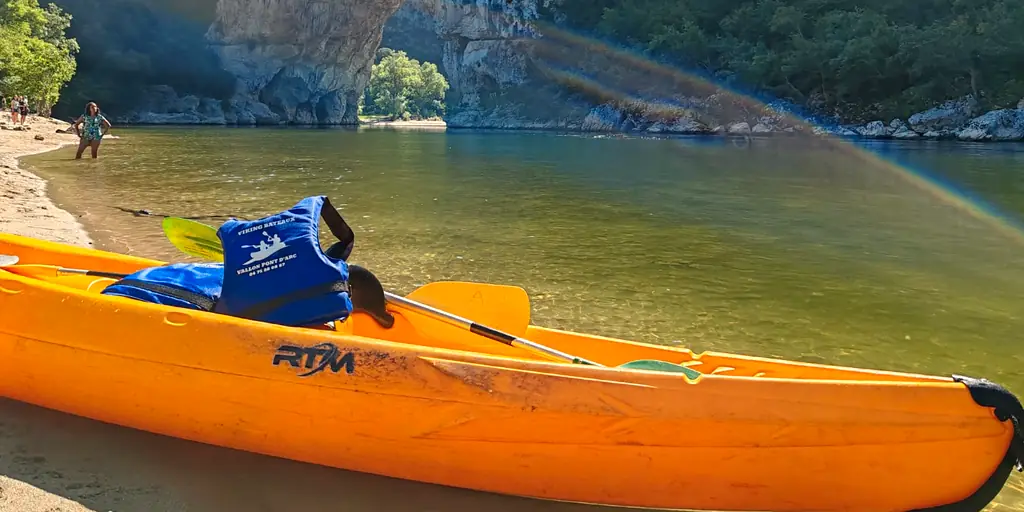
The two words are often used as if they meant the same boat. At a rental base the question is mostly practical: do you want to paddle as a pair in a roomier boat, or on your own in a livelier kayak?
Canoe and kayak: the difference in sporting terms
In competitive disciplines the distinction is clear. A canoeist traditionally kneels and uses a single-bladed paddle. A kayaker sits and uses a double-bladed one.
That definition still holds, but it does not describe what a leisure descent in the Ardèche actually looks like. Rental boats are built to be stable, tough and easy to empty after a capsize. They resemble neither a Canadian canoe loaded for an expedition nor a closed racing kayak.
In everyday speech, "going canoeing" therefore often means the activity as a whole. On site, the useful choice is really between a two-seater boat and a single kayak.
What Viking Bateaux offers
Our fleet includes two-seater canoes and single kayaks. The boat is allocated according to your preference, your age, the route and what is available that day.
The price includes the buoyancy aid, the paddle or paddles, a 30-litre dry barrel, the briefing before departure and the return shuttle. On some full-day trips a central third seat can take a child under 35 kg. That option is not offered on the bivouac trips and should be confirmed when booking.
The single kayak is available from age 14 with parental consent. It asks for more self-reliance: nobody paddles for you when your arms start to tire.
The quick comparison
| Criterion | Two-seater canoe | Single kayak |
|---|---|---|
| Number of paddlers | Two, sometimes with a child seat depending on the trip | One person only |
| Effort | Shared between the two adults or teenagers | Entirely on the paddler |
| Coordination | You have to paddle together and talk to each other | Everyone picks their own line |
| Felt stability | Reassuring for most beginners | More mobile and responsive |
| Group feel | You share the boat and the breaks | More independence on the water |
| Bivouac | Handy for spreading the gear between you | You manage your own effort and load alone |
| Best suited to | Couples, families, first descents | Older teenagers, self-reliant adults, confident paddlers |
Why the two-seater suits a first descent better
As a pair you share the effort and the decisions. The person at the front sets the rhythm and spots obstacles; the one at the back does more of the steering. It takes a few minutes to fall into step, then the movements become natural.
That set-up reassures when one of you is less sporty or less at ease on the water. It also keeps a child in the same boat as an adult rather than multiplying the number of boats.
The main drawback appears when both paddlers try to steer at once. A canoe that zigzags rarely has a hull problem: its two occupants simply are not yet paddling to the same rhythm. The briefing exists precisely to avoid having that conversation at the first rapid.
Why choose a single kayak
The kayak appeals to people who want to control their own line. No waiting for a partner to switch sides or to realise it is time to stop paddling: the response is immediate.
That freedom comes at a price. Over 24, 30 or 36 km you supply all the effort yourself. A confident paddler will enjoy it a great deal; someone short on stamina will quickly regret not being able to hand the paddle over.
The single is also more sensitive to body movement. That is not a flaw, but the feeling can be surprising the first time you get in. Take a moment to test your balance near the bank before joining the current.
Family, couple, group of friends
Which boat for a family?
With a child, the two-seater canoe is the simplest answer. The adult keeps the young paddler in the same boat, controls the pace and can provide most of the propulsion when they tire.
For a family of three, some trips allow a child under 35 kg to sit in the middle. Above that weight, or if the child is big enough to paddle, the team splits the group across several boats.
The minimum age is 7. Every participant must be able to swim 25 metres and be comfortable being fully immersed. The buoyancy aid is compulsory for the whole descent.
Which boat for a couple?
The two-seater canoe means you never lose sight of each other and can share your belongings. It is the obvious choice if one of you is new to the activity or if your fitness levels differ.
Two single kayaks suit a couple already at ease, when each of you would rather choose your own line and pace. That does not mean paddling separately: you still need to wait for each other before the rapids and at the meeting points given during the briefing.
Which boat for a group of friends?
A mix of canoes and kayaks works very well, provided you pair people up before setting off. Put together two people who can communicate without turning every bend into a debate. The most self-reliant paddlers can take the singles.
For a large group, the choice of route matters more than the number of kayaks. A 12 km trip keeps different abilities reasonably close together. On a 36 km, the gaps in stamina widen as the day goes on.
Choosing your route to suit the group
What about a two-day bivouac?
The two-seater canoe makes it easier to spread both the gear and the effort. It remains the boat we recommend most often for a first night at Gaud or Gournier.
An experienced kayaker may prefer the independence, but they need to be able to hold the distance two days running and to organise their own load. The weight of the gear shows when you pick up speed after a break and in the passages where the line has to be corrected quickly.
Either way, travel light. A sleeping bag, a change of clothes, a head torch, cold meals and the safety kit already take up a good part of the available space.
Preparing your bivouac in the Gorges
Does the choice change with distance?
For 6 or 12 km
The two-seater canoe suits almost every beginner. The kayak is a pleasant option for an adult or an older teenager who wants to try going solo without committing to a full day.
For 24 or 30 km
Stamina starts to matter. If you are hesitating, share the effort between two. Pick a single because you want one and feel able to keep going for several hours, not simply because the queue looks shorter at the start.
For 36 km
The Full Run calls for a steady pace. In a kayak, every drop in rhythm is paid for directly in your arrival time. The two-seater lets you alternate intensity, provided both paddlers cooperate.
For two days
Carrying comfort and next-day tiredness become the priority. For a first experience, the two-seater remains the safe choice.
Can you decide once you get to the base?
We do our best with the boats available, but the choice cannot always be guaranteed at the last minute, especially in July and August. Mention your preference when booking, or get in touch before you set off.
The team may also advise against a single if the age, the route or the conditions do not lend themselves to it. That is not a penalty: better to change boat on the bank than to discover several kilometres in that the choice was too ambitious.
Frequently asked questions
1 Is a canoe easier than a kayak?
For a first descent, the two-seater canoe usually feels simpler because the effort is shared. The single kayak steers more intuitively, but you have to manage everything on your own.
2 Is a canoe more stable than a kayak?
Every rental boat is built for stability. The two-seater is often felt as more reassuring; the single reacts more to the paddler's movements. Body position matters as much as the model.
3 Can three people share a canoe?
A third seat is available on some trips for a child under 35 kg. Check availability and price before booking. It is not offered on the bivouac trips.
4 Can a child take a kayak alone?
At Viking Bateaux the single kayak is available from age 14 with parental consent, subject to the route and availability. Younger paddlers travel with an adult.
5 Do I need to know how to paddle already?
Not for the routes open to beginners. The briefing covers the basic strokes and the safety rules. You do, however, need to be at least 7 years old, able to swim 25 metres and comfortable being fully immersed.
6 Which boat is faster?
Speed depends far more on rhythm, line and coordination than on the name of the boat. A well-handled two-seater moves easily; a badly steered kayak mostly covers more of the river's width.
Still unsure? Choose a two-seater canoe for a first outing, a family, a couple with different fitness levels or a bivouac. Take a single kayak if you are at least 14, at ease on the water and want to handle your own navigation. Tell us the age of the participants, the distance you have in mind and your experience: we will point you to the boat that makes the most sense when we get you ready to set off.